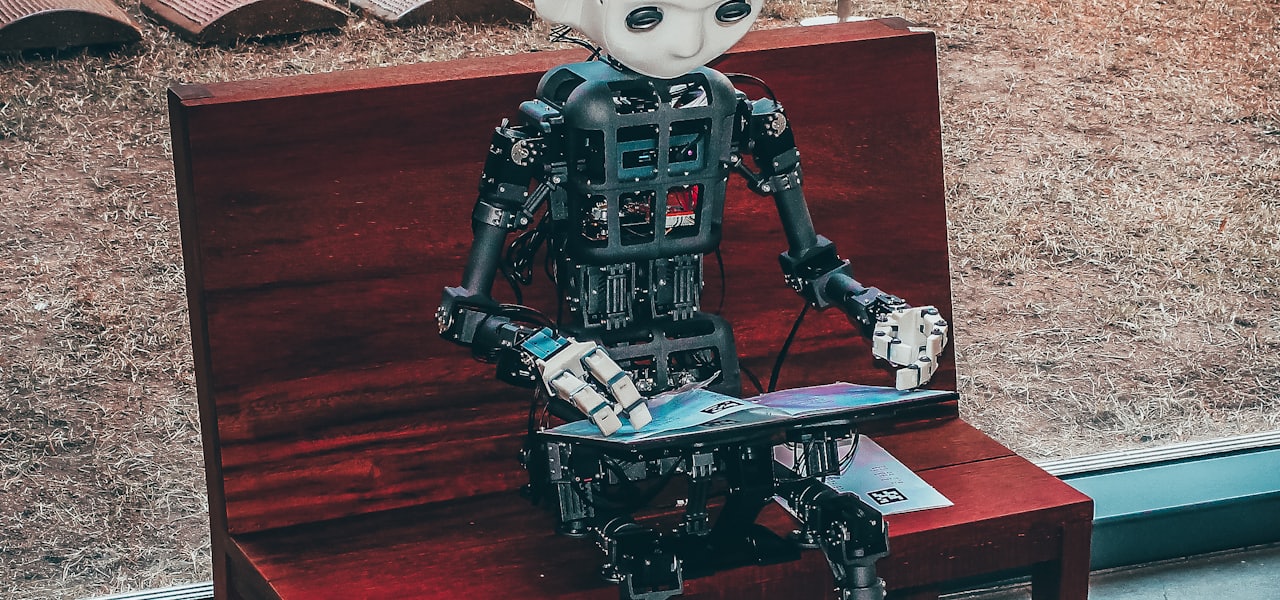
The impact of artificial intelligence on workers includes both applications to improve worker safety and health, and potential hazards that must be controlled. One potential application is using AI to eliminate hazards by removing humans from hazardous situations that involve risk of stress, overwork, or musculoskeletal injuries. Predictive analytics may also be used to identify conditions that may lead to hazards such as fatigue, repetitive strain injuries, or toxic substance exposure, leading to earlier interventions. Another is to streamline workplace safety and health workflows through automating repetitive tasks, enhancing safety training programs through virtual reality, or detecting and reporting near misses. When used in the workplace, AI also presents the possibility of new hazards. These may arise from machine learning techniques leading to unpredictable behavior and inscrutability in their decision-making, or from cybersecurity and information privacy issues. Many hazards of AI are psychosocial due to its potential to cause changes in work organization. These include increased monitoring leading to micromanagement, algorithms unintentionally or intentionally mimicking undesirable human biases, and assigning blame for machine errors to the human operator instead. AI may also lead to physical hazards in the form of human–robot collisions, and ergonomic risks of control interfaces and human–machine interactions. Hazard controls include cybersecurity and information privacy measures, communication and transparency with workers about data usage, and limitations on collaborative robots. From a workplace safety and health perspective, only "weak" or "narrow" AI that is tailored to a specific task is relevant, as there are many examples that are currently in use or expected to come into use in the near future. Certain digital technologies are predicted to result in job losses. Starting in the 2020s, the adoption of modern robotics has led to net employment growth. However, many businesses anticipate that automation, or employing robots would result in job losses in the future. This is especially true for companies in Central and Eastern Europe. Other digital technologies, such as platforms or big data, are projected to have a more neutral impact on employment. A large number of tech workers have been laid off starting in 2023; many such job cuts have been attributed to artificial intelligence. == Health and safety applications == In order for any potential AI health and safety application to be adopted, it requires acceptance by both managers and workers. For example, worker acceptance may be diminished by concerns about information privacy, or from a lack of trust and acceptance of the new technology, which may arise from inadequate transparency or training. Alternatively, managers may emphasize increases in economic productivity rather than gains in worker safety and health when implementing AI-based systems. === Eliminating hazardous tasks === AI may increase the scope of work tasks where a worker can be removed from a situation that carries risk. In a sense, while traditional automation can replace the functions of a worker's body with a robot, AI effectively replaces the functions of their brain with a computer. Hazards that can be avoided include stress, overwork, musculoskeletal injuries, and boredom. This can expand the range of affected job sectors into white-collar and service sector jobs such as in medicine, finance, and information technology. === Analytics to reduce risk === Machine learning is used for people analytics to make predictions about worker behavior to assist management decision-making, such as hiring and performance assessment. These could also be used to improve worker health. The analytics may be based on inputs such as online activities, monitoring of communications, location tracking, and voice analysis and body language analysis of filmed interviews. For example, sentiment analysis may be used to spot fatigue to prevent overwork. Decision support systems have a similar ability to be used to, for example, prevent industrial disasters or make disaster response more efficient. For manual material handling workers, predictive analytics and artificial intelligence may be used to reduce musculoskeletal injury. Traditional guidelines are based on statistical averages and are geared towards anthropometrically typical humans. The analysis of large amounts of data from wearable sensors may allow real-time, personalized calculation of ergonomic risk and fatigue management, as well as better analysis of the risk associated with specific job roles. Wearable sensors may also enable earlier intervention against exposure to toxic substances than is possible with area or breathing zone testing on a periodic basis. Furthermore, the large data sets generated could improve workplace health surveillance, risk assessment, and research. === Streamlining safety and health workflows === AI has also been used to attempt to make the workplace safety and health workflow more efficient. One example is coding of workers' compensation claims, which are submitted in a prose narrative form and must manually be assigned standardized codes. AI is being investigated to perform this task faster, more cheaply, and with fewer errors. == Hazards == There are several broad aspects of AI that may give rise to specific hazards. The risks depend on implementation rather than the mere presence of AI. Systems using sub-symbolic AI such as machine learning may behave unpredictably and are more prone to inscrutability in their decision-making. This is especially true if a situation is encountered that was not part of the AI's training dataset, and is exacerbated in environments that are less structured. Undesired behavior may also arise from flaws in the system's perception (arising either from within the software or from sensor degradation), knowledge representation and reasoning, or from software bugs. They may arise from improper training, such as a user applying the same algorithm to two problems that do not have the same requirements. Machine learning applied during the design phase may have different implications than that applied at runtime. Systems using symbolic AI are less prone to unpredictable behavior. The use of AI also increases cybersecurity risks relative to platforms that do not use AI, and information privacy concerns about collected data may pose a hazard to workers. === Psychosocial === Psychosocial hazards are those that arise from the way work is designed, organized, and managed, or its economic and social contexts, rather than arising from a physical substance or object. They cause not only psychiatric and psychological outcomes such as occupational burnout, anxiety disorders, and depression, but they can also cause physical injury or illness such as cardiovascular disease or musculoskeletal injury. Many hazards of AI are psychosocial in nature due to its potential to cause changes in work organization, in terms of increasing complexity and interaction between different organizational factors. However, psychosocial risks are often overlooked by designers of advanced manufacturing systems. Einola and Khoreva explore how different organizational groups perceive and interact with AI technologies. Their research shows that successful AI integration depends on human ownership and contextual understanding. They caution against blind technological optimism and stress the importance of tailoring AI use to specific workplace ecosystems. This perspective reinforces the need for inclusive design and transparent implementation strategies. ==== Changes in work practices ==== Over-reliance on AI tools may lead to deskilling of some professions. When AI becomes a substitute for traditional peer collaboration and mentorship, there is a risk of diminishing opportunities for interpersonal skill development and team-based learning. Increased monitoring may lead to micromanagement and thus to stress and anxiety. A perception of surveillance may also lead to stress. Controls for these include consultation with worker groups, extensive testing, and attention to introduced bias. Wearable sensors, activity trackers, and augmented reality may also lead to stress from micromanagement, both for assembly line workers and gig workers. Gig workers also lack the legal protections and rights of formal workers. Newell & Marabelli argue that AI alters power dynamics and employee autonomy, requiring a more nuanced understanding of its social and organizational implications. There is also the risk of people being forced to work at a robot's pace, or to monitor robot performance at nonstandard hours. A 2025 preprint paper based on users' interactions with the AI chatbot Microsoft Copilot identified forty jobs that the author's claimed had high overlaps with the capabilities of AI. Some media outlets used this paper to report on jobs becoming obsolete. Cri
Hugging Face
Hugging Face, Inc., is an American company based in New York City that develops computation tools for building applications using machine learning. Its transformers library built for natural language processing applications and its platform allow users to share machine learning models and datasets and showcase their work. == History == === Founding === The company was founded in 2016 by French entrepreneurs Clément Delangue, Julien Chaumond, and Thomas Wolf in New York City, originally as a company that developed a chatbot app targeted at teenagers. The company was named after the U+1F917 🤗 HUGGING FACE emoji. After open sourcing the model behind the chatbot, the company pivoted to focus on being a platform for machine learning. === AI boom === On April 28, 2021, the company launched the BigScience Research Workshop in collaboration with several other research groups to release an open large language model. In 2022, the workshop concluded with the announcement of BLOOM, a multilingual large language model with 176 billion parameters. In February 2023, the company announced partnership with Amazon Web Services (AWS) which would allow Hugging Face's products to be available to AWS customers to use them as the building blocks for their custom applications. The company also said the next generation of BLOOM will be run on Trainium, a proprietary machine learning chip created by AWS. In June 2024, the company announced, along with Meta and Scaleway, their launch of a new AI accelerator program for European startups. The initiative aimed to help startups integrate open foundation models into their products, accelerating the EU AI ecosystem. The program, based at STATION F in Paris, ran from September 2024 to February 2025. Selected startups received mentoring, and access to AI models and tools and Scaleway's computing power. On September 23, 2024, to further the International Decade of Indigenous Languages, Hugging Face teamed up with Meta and UNESCO to launch a new online language translator. It was built on Meta's No Language Left Behind open-source AI model, enabling free text translation across 200 languages, including many low-resource languages. In April 2025, Hugging Face announced that they acquired a humanoid robotics startup, Pollen Robotics, based in France and founded by Matthieu Lapeyre and Pierre Rouanet in 2016. In an X tweet, Delangue shared his vision to "make Artificial Intelligence robotics Open Source". === Cyberattacks === In early 2026, hackers hijacked the Hugging Face platform to launch Android-targeted attacks involving "powerful malware" which could completely take over a compromised target.
Alternating decision tree
An alternating decision tree (ADTree) is a machine learning method for classification. It generalizes decision trees and has connections to boosting. An ADTree consists of an alternation of decision nodes, which specify a predicate condition, and prediction nodes, which contain a single number. An instance is classified by an ADTree by following all paths for which all decision nodes are true, and summing any prediction nodes that are traversed. == History == ADTrees were introduced by Yoav Freund and Llew Mason. However, the algorithm as presented had several typographical errors. Clarifications and optimizations were later presented by Bernhard Pfahringer, Geoffrey Holmes and Richard Kirkby. Implementations are available in Weka and JBoost. == Motivation == Original boosting algorithms typically used either decision stumps or decision trees as weak hypotheses. As an example, boosting decision stumps creates a set of T {\displaystyle T} weighted decision stumps (where T {\displaystyle T} is the number of boosting iterations), which then vote on the final classification according to their weights. Individual decision stumps are weighted according to their ability to classify the data. Boosting a simple learner results in an unstructured set of T {\displaystyle T} hypotheses, making it difficult to infer correlations between attributes. Alternating decision trees introduce structure to the set of hypotheses by requiring that they build off a hypothesis that was produced in an earlier iteration. The resulting set of hypotheses can be visualized in a tree based on the relationship between a hypothesis and its "parent." Another important feature of boosted algorithms is that the data is given a different distribution at each iteration. Instances that are misclassified are given a larger weight while accurately classified instances are given reduced weight. == Alternating decision tree structure == An alternating decision tree consists of decision nodes and prediction nodes. Decision nodes specify a predicate condition. Prediction nodes contain a single number. ADTrees always have prediction nodes as both root and leaves. An instance is classified by an ADTree by following all paths for which all decision nodes are true and summing any prediction nodes that are traversed. This is different from binary classification trees such as CART (Classification and regression tree) or C4.5 in which an instance follows only one path through the tree. === Example === The following tree was constructed using JBoost on the spambase dataset (available from the UCI Machine Learning Repository). In this example, spam is coded as 1 and regular email is coded as −1. The following table contains part of the information for a single instance. The instance is scored by summing all of the prediction nodes through which it passes. In the case of the instance above, the score is calculated as The final score of 0.657 is positive, so the instance is classified as spam. The magnitude of the value is a measure of confidence in the prediction. The original authors list three potential levels of interpretation for the set of attributes identified by an ADTree: Individual nodes can be evaluated for their own predictive ability. Sets of nodes on the same path may be interpreted as having a joint effect The tree can be interpreted as a whole. Care must be taken when interpreting individual nodes as the scores reflect a re weighting of the data in each iteration. == Description of the algorithm == The inputs to the alternating decision tree algorithm are: A set of inputs ( x 1 , y 1 ) , … , ( x m , y m ) {\displaystyle (x_{1},y_{1}),\ldots ,(x_{m},y_{m})} where x i {\displaystyle x_{i}} is a vector of attributes and y i {\displaystyle y_{i}} is either -1 or 1. Inputs are also called instances. A set of weights w i {\displaystyle w_{i}} corresponding to each instance. The fundamental element of the ADTree algorithm is the rule. A single rule consists of a precondition, a condition, and two scores. A condition is a predicate of the form "attribute
Large margin nearest neighbor
Large margin nearest neighbor (LMNN) classification is a statistical machine learning algorithm for metric learning. It learns a pseudometric designed for k-nearest neighbor classification. The algorithm is based on semidefinite programming, a sub-class of convex optimization. The goal of supervised learning (more specifically classification) is to learn a decision rule that can categorize data instances into pre-defined classes. The k-nearest neighbor rule assumes a training data set of labeled instances (i.e. the classes are known). It classifies a new data instance with the class obtained from the majority vote of the k closest (labeled) training instances. Closeness is measured with a pre-defined metric. Large margin nearest neighbors is an algorithm that learns this global (pseudo-)metric in a supervised fashion to improve the classification accuracy of the k-nearest neighbor rule. == Setup == The main intuition behind LMNN is to learn a pseudometric under which all data instances in the training set are surrounded by at least k instances that share the same class label. If this is achieved, the leave-one-out error (a special case of cross validation) is minimized. Let the training data consist of a data set D = { ( x → 1 , y 1 ) , … , ( x → n , y n ) } ⊂ R d × C {\displaystyle D=\{({\vec {x}}_{1},y_{1}),\dots ,({\vec {x}}_{n},y_{n})\}\subset R^{d}\times C} , where the set of possible class categories is C = { 1 , … , c } {\displaystyle C=\{1,\dots ,c\}} . The algorithm learns a pseudometric of the type d ( x → i , x → j ) = ( x → i − x → j ) ⊤ M ( x → i − x → j ) {\displaystyle d({\vec {x}}_{i},{\vec {x}}_{j})=({\vec {x}}_{i}-{\vec {x}}_{j})^{\top }\mathbf {M} ({\vec {x}}_{i}-{\vec {x}}_{j})} . For d ( ⋅ , ⋅ ) {\displaystyle d(\cdot ,\cdot )} to be well defined, the matrix M {\displaystyle \mathbf {M} } needs to be positive semi-definite. The Euclidean metric is a special case, where M {\displaystyle \mathbf {M} } is the identity matrix. This generalization is often (falsely) referred to as Mahalanobis metric. Figure 1 illustrates the effect of the metric under varying M {\displaystyle \mathbf {M} } . The two circles show the set of points with equal distance to the center x → i {\displaystyle {\vec {x}}_{i}} . In the Euclidean case this set is a circle, whereas under the modified (Mahalanobis) metric it becomes an ellipsoid. The algorithm distinguishes between two types of special data points: target neighbors and impostors. === Target neighbors === Target neighbors are selected before learning. Each instance x → i {\displaystyle {\vec {x}}_{i}} has exactly k {\displaystyle k} different target neighbors within D {\displaystyle D} , which all share the same class label y i {\displaystyle y_{i}} . The target neighbors are the data points that should become nearest neighbors under the learned metric. Let us denote the set of target neighbors for a data point x → i {\displaystyle {\vec {x}}_{i}} as N i {\displaystyle N_{i}} . === Impostors === An impostor of a data point x → i {\displaystyle {\vec {x}}_{i}} is another data point x → j {\displaystyle {\vec {x}}_{j}} with a different class label (i.e. y i ≠ y j {\displaystyle y_{i}\neq y_{j}} ) which is one of the nearest neighbors of x → i {\displaystyle {\vec {x}}_{i}} . During learning the algorithm tries to minimize the number of impostors for all data instances in the training set. == Algorithm == Large margin nearest neighbors optimizes the matrix M {\displaystyle \mathbf {M} } with the help of semidefinite programming. The objective is twofold: For every data point x → i {\displaystyle {\vec {x}}_{i}} , the target neighbors should be close and the impostors should be far away. Figure 1 shows the effect of such an optimization on an illustrative example. The learned metric causes the input vector x → i {\displaystyle {\vec {x}}_{i}} to be surrounded by training instances of the same class. If it was a test point, it would be classified correctly under the k = 3 {\displaystyle k=3} nearest neighbor rule. The first optimization goal is achieved by minimizing the average distance between instances and their target neighbors ∑ i , j ∈ N i d ( x → i , x → j ) {\displaystyle \sum _{i,j\in N_{i}}d({\vec {x}}_{i},{\vec {x}}_{j})} . The second goal is achieved by penalizing distances to impostors x → l {\displaystyle {\vec {x}}_{l}} that are less than one unit further away than target neighbors x → j {\displaystyle {\vec {x}}_{j}} (and therefore pushing them out of the local neighborhood of x → i {\displaystyle {\vec {x}}_{i}} ). The resulting value to be minimized can be stated as: ∑ i , j ∈ N i , l , y l ≠ y i [ d ( x → i , x → j ) + 1 − d ( x → i , x → l ) ] + {\displaystyle \sum _{i,j\in N_{i},l,y_{l}\neq y_{i}}[d({\vec {x}}_{i},{\vec {x}}_{j})+1-d({\vec {x}}_{i},{\vec {x}}_{l})]_{+}} With a hinge loss function [ ⋅ ] + = max ( ⋅ , 0 ) {\textstyle [\cdot ]_{+}=\max(\cdot ,0)} , which ensures that impostor proximity is not penalized when outside the margin. The margin of exactly one unit fixes the scale of the matrix M {\displaystyle M} . Any alternative choice c > 0 {\displaystyle c>0} would result in a rescaling of M {\displaystyle M} by a factor of 1 / c {\displaystyle 1/c} . The final optimization problem becomes: min M ∑ i , j ∈ N i d ( x → i , x → j ) + λ ∑ i , j , l ξ i j l {\displaystyle \min _{\mathbf {M} }\sum _{i,j\in N_{i}}d({\vec {x}}_{i},{\vec {x}}_{j})+\lambda \sum _{i,j,l}\xi _{ijl}} ∀ i , j ∈ N i , l , y l ≠ y i {\displaystyle \forall _{i,j\in N_{i},l,y_{l}\neq y_{i}}} d ( x → i , x → j ) + 1 − d ( x → i , x → l ) ≤ ξ i j l {\displaystyle d({\vec {x}}_{i},{\vec {x}}_{j})+1-d({\vec {x}}_{i},{\vec {x}}_{l})\leq \xi _{ijl}} ξ i j l ≥ 0 {\displaystyle \xi _{ijl}\geq 0} M ⪰ 0 {\displaystyle \mathbf {M} \succeq 0} The hyperparameter λ > 0 {\textstyle \lambda >0} is some positive constant (typically set through cross-validation). Here the variables ξ i j l {\displaystyle \xi _{ijl}} (together with two types of constraints) replace the term in the cost function. They play a role similar to slack variables to absorb the extent of violations of the impostor constraints. The last constraint ensures that M {\displaystyle \mathbf {M} } is positive semi-definite. The optimization problem is an instance of semidefinite programming (SDP). Although SDPs tend to suffer from high computational complexity, this particular SDP instance can be solved very efficiently due to the underlying geometric properties of the problem. In particular, most impostor constraints are naturally satisfied and do not need to be enforced during runtime (i.e. the set of variables ξ i j l {\displaystyle \xi _{ijl}} is sparse). A particularly well suited solver technique is the working set method, which keeps a small set of constraints that are actively enforced and monitors the remaining (likely satisfied) constraints only occasionally to ensure correctness. == Extensions and efficient solvers == LMNN was extended to multiple local metrics in the 2008 paper. This extension significantly improves the classification error, but involves a more expensive optimization problem. In their 2009 publication in the Journal of Machine Learning Research, Weinberger and Saul derive an efficient solver for the semi-definite program. It can learn a metric for the MNIST handwritten digit data set in several hours, involving billions of pairwise constraints. An open source Matlab implementation is freely available at the authors web page. Kumal et al. extended the algorithm to incorporate local invariances to multivariate polynomial transformations and improved regularization.
AdaBoost
AdaBoost (short for Adaptive Boosting) is a statistical classification meta-algorithm formulated by Yoav Freund and Robert Schapire in 1995, who won the 2003 Gödel Prize for their work. It can be used in conjunction with many types of learning algorithm to improve performance. The output of multiple weak learners is combined into a weighted sum that represents the final output of the boosted classifier. Usually, AdaBoost is presented for binary classification, although it can be generalized to multiple classes or bounded intervals of real values. AdaBoost is adaptive in the sense that subsequent weak learners (models) are adjusted in favor of instances misclassified by previous models. In some problems, it can be less susceptible to overfitting than other learning algorithms. The individual learners can be weak, but as long as the performance of each one is slightly better than random guessing, the final model can be proven to converge to a strong learner. Although AdaBoost is typically used to combine weak base learners (such as decision stumps), it has been shown to also effectively combine strong base learners (such as deeper decision trees), producing an even more accurate model. Every learning algorithm tends to suit some problem types better than others, and typically has many different parameters and configurations to adjust before it achieves optimal performance on a dataset. AdaBoost (with decision trees as the weak learners) is often referred to as the best out-of-the-box classifier. When used with decision tree learning, information gathered at each stage of the AdaBoost algorithm about the relative 'hardness' of each training sample is fed into the tree-growing algorithm such that later trees tend to focus on harder-to-classify examples. == Training == AdaBoost refers to a particular method of training a boosted classifier. A boosted classifier is a classifier of the form F T ( x ) = ∑ t = 1 T f t ( x ) {\displaystyle F_{T}(x)=\sum _{t=1}^{T}f_{t}(x)} where each f t {\displaystyle f_{t}} is a weak learner that takes an object x {\displaystyle x} as input and returns a value indicating the class of the object. For example, in the two-class problem, the sign of the weak learner's output identifies the predicted object class and the absolute value gives the confidence in that classification. Each weak learner produces an output hypothesis h {\displaystyle h} which fixes a prediction h ( x i ) {\displaystyle h(x_{i})} for each sample in the training set. At each iteration t {\displaystyle t} , a weak learner is selected and assigned a coefficient α t {\displaystyle \alpha _{t}} such that the total training error E t {\displaystyle E_{t}} of the resulting t {\displaystyle t} -stage boosted classifier is minimized. E t = ∑ i E [ F t − 1 ( x i ) + α t h ( x i ) ] {\displaystyle E_{t}=\sum _{i}E[F_{t-1}(x_{i})+\alpha _{t}h(x_{i})]} Here F t − 1 ( x ) {\displaystyle F_{t-1}(x)} is the boosted classifier that has been built up to the previous stage of training and f t ( x ) = α t h ( x ) {\displaystyle f_{t}(x)=\alpha _{t}h(x)} is the weak learner that is being considered for addition to the final classifier. === Weighting === At each iteration of the training process, a weight w i , t {\displaystyle w_{i,t}} is assigned to each sample in the training set equal to the current error E ( F t − 1 ( x i ) ) {\displaystyle E(F_{t-1}(x_{i}))} on that sample. These weights can be used in the training of the weak learner. For instance, decision trees can be grown which favor the splitting of sets of samples with large weights. == Derivation == This derivation follows Rojas (2009): Suppose we have a data set { ( x 1 , y 1 ) , … , ( x N , y N ) } {\displaystyle \{(x_{1},y_{1}),\ldots ,(x_{N},y_{N})\}} where each item x i {\displaystyle x_{i}} has an associated class y i ∈ { − 1 , 1 } {\displaystyle y_{i}\in \{-1,1\}} , and a set of weak classifiers { k 1 , … , k L } {\displaystyle \{k_{1},\ldots ,k_{L}\}} each of which outputs a classification k j ( x i ) ∈ { − 1 , 1 } {\displaystyle k_{j}(x_{i})\in \{-1,1\}} for each item. After the ( m − 1 ) {\displaystyle (m-1)} -th iteration our boosted classifier is a linear combination of the weak classifiers of the form: C ( m − 1 ) ( x i ) = α 1 k 1 ( x i ) + ⋯ + α m − 1 k m − 1 ( x i ) , {\displaystyle C_{(m-1)}(x_{i})=\alpha _{1}k_{1}(x_{i})+\cdots +\alpha _{m-1}k_{m-1}(x_{i}),} where the class will be the sign of C ( m − 1 ) ( x i ) {\displaystyle C_{(m-1)}(x_{i})} . At the m {\displaystyle m} -th iteration we want to extend this to a better boosted classifier by adding another weak classifier k m {\displaystyle k_{m}} , with another weight α m {\displaystyle \alpha _{m}} : C m ( x i ) = C ( m − 1 ) ( x i ) + α m k m ( x i ) {\displaystyle C_{m}(x_{i})=C_{(m-1)}(x_{i})+\alpha _{m}k_{m}(x_{i})} So it remains to determine which weak classifier is the best choice for k m {\displaystyle k_{m}} , and what its weight α m {\displaystyle \alpha _{m}} should be. We define the total error E {\displaystyle E} of C m {\displaystyle C_{m}} as the sum of its exponential loss on each data point, given as follows: E = ∑ i = 1 N e − y i C m ( x i ) = ∑ i = 1 N e − y i C ( m − 1 ) ( x i ) e − y i α m k m ( x i ) {\displaystyle E=\sum _{i=1}^{N}e^{-y_{i}C_{m}(x_{i})}=\sum _{i=1}^{N}e^{-y_{i}C_{(m-1)}(x_{i})}e^{-y_{i}\alpha _{m}k_{m}(x_{i})}} Letting w i ( 1 ) = 1 {\displaystyle w_{i}^{(1)}=1} and w i ( m ) = e − y i C m − 1 ( x i ) {\displaystyle w_{i}^{(m)}=e^{-y_{i}C_{m-1}(x_{i})}} for m > 1 {\displaystyle m>1} , we have: E = ∑ i = 1 N w i ( m ) e − y i α m k m ( x i ) {\displaystyle E=\sum _{i=1}^{N}w_{i}^{(m)}e^{-y_{i}\alpha _{m}k_{m}(x_{i})}} We can split this summation between those data points that are correctly classified by k m {\displaystyle k_{m}} (so y i k m ( x i ) = 1 {\displaystyle y_{i}k_{m}(x_{i})=1} ) and those that are misclassified (so y i k m ( x i ) = − 1 {\displaystyle y_{i}k_{m}(x_{i})=-1} ): E = ∑ y i = k m ( x i ) w i ( m ) e − α m + ∑ y i ≠ k m ( x i ) w i ( m ) e α m = ∑ i = 1 N w i ( m ) e − α m + ∑ y i ≠ k m ( x i ) w i ( m ) ( e α m − e − α m ) {\displaystyle {\begin{aligned}E&=\sum _{y_{i}=k_{m}(x_{i})}w_{i}^{(m)}e^{-\alpha _{m}}+\sum _{y_{i}\neq k_{m}(x_{i})}w_{i}^{(m)}e^{\alpha _{m}}\\&=\sum _{i=1}^{N}w_{i}^{(m)}e^{-\alpha _{m}}+\sum _{y_{i}\neq k_{m}(x_{i})}w_{i}^{(m)}\left(e^{\alpha _{m}}-e^{-\alpha _{m}}\right)\end{aligned}}} Since the only part of the right-hand side of this equation that depends on k m {\displaystyle k_{m}} is ∑ y i ≠ k m ( x i ) w i ( m ) {\textstyle \sum _{y_{i}\neq k_{m}(x_{i})}w_{i}^{(m)}} , we see that the k m {\displaystyle k_{m}} that minimizes E {\displaystyle E} is the one in the set { k 1 , … , k L } {\displaystyle \{k_{1},\ldots ,k_{L}\}} that minimizes ∑ y i ≠ k m ( x i ) w i ( m ) {\textstyle \sum _{y_{i}\neq k_{m}(x_{i})}w_{i}^{(m)}} [assuming that α m > 0 {\displaystyle \alpha _{m}>0} ], i.e. the weak classifier with the lowest weighted error (with weights w i ( m ) = e − y i C m − 1 ( x i ) {\displaystyle w_{i}^{(m)}=e^{-y_{i}C_{m-1}(x_{i})}} ). To determine the desired weight α m {\displaystyle \alpha _{m}} that minimizes E {\displaystyle E} with the k m {\displaystyle k_{m}} that we just determined, we differentiate: d E d α m = d ( ∑ y i = k m ( x i ) w i ( m ) e − α m + ∑ y i ≠ k m ( x i ) w i ( m ) e α m ) d α m {\displaystyle {\frac {dE}{d\alpha _{m}}}={\frac {d(\sum _{y_{i}=k_{m}(x_{i})}w_{i}^{(m)}e^{-\alpha _{m}}+\sum _{y_{i}\neq k_{m}(x_{i})}w_{i}^{(m)}e^{\alpha _{m}})}{d\alpha _{m}}}} The value of α m {\displaystyle \alpha _{m}} that minimizes the above expression is: α m = 1 2 ln ( ∑ y i = k m ( x i ) w i ( m ) ∑ y i ≠ k m ( x i ) w i ( m ) ) {\displaystyle \alpha _{m}={\frac {1}{2}}\ln \left({\frac {\sum _{y_{i}=k_{m}(x_{i})}w_{i}^{(m)}}{\sum _{y_{i}\neq k_{m}(x_{i})}w_{i}^{(m)}}}\right)} We calculate the weighted error rate of the weak classifier to be ϵ m = ∑ y i ≠ k m ( x i ) w i ( m ) ∑ i = 1 N w i ( m ) {\displaystyle \epsilon _{m}={\frac {\sum _{y_{i}\neq k_{m}(x_{i})}w_{i}^{(m)}}{\sum _{i=1}^{N}w_{i}^{(m)}}}} , so it follows that: α m = 1 2 ln ( 1 − ϵ m ϵ m ) {\displaystyle \alpha _{m}={\frac {1}{2}}\ln \left({\frac {1-\epsilon _{m}}{\epsilon _{m}}}\right)} which is the negative logit function multiplied by 0.5. Due to the convexity of E {\displaystyle E} as a function of α m {\displaystyle \alpha _{m}} , this new expression for α m {\displaystyle \alpha _{m}} gives the global minimum of the loss function. Note: This derivation only applies when k m ( x i ) ∈ { − 1 , 1 } {\displaystyle k_{m}(x_{i})\in \{-1,1\}} , though it can be a good starting guess in other cases, such as when the weak learner is biased ( k m ( x ) ∈ { a , b } , a ≠ − b {\displaystyle k_{m}(x)\in \{a,b\},a\neq -b} ), has multiple leaves ( k m ( x ) ∈ { a , b , … , n } {\displaystyle k_{m}(x)\in \{a,b,\dots ,n\}} ) or is some other function k m ( x ) ∈ R {\displaystyle k_{m}(x)\in \mathbb {R} } . Thus we have derived the AdaBoost algorithm: At each
Clapper (service)
Clapper is an American short-form video-hosting service headquartered in Dallas, Texas. It was founded in 2020 by Edison Chen as an alternative for TikTok for mature audiences. The app is functionally similar to TikTok and includes tipping and e-commerce features. Following an influx of far-right content in early 2021, Clapper strengthened its moderation practices. It achieved 2 million monthly active users by 2023, and the number of downloads increased after a U.S. bill that would potentially ban TikTok in the country was signed in 2024. == History == With its offices in Dallas, Texas, Clapper was founded in July 2020 by Chinese-American entrepreneur Edison Chen. Chen considered that most online platforms, such as TikTok, were being targeted to young generations, such as Generation Z. He then concepted Clapper as a service with short-form content for mature audiences among Generation X and millennials, while not intending to compete directly with TikTok. Clapper averaged fewer than ten thousand daily active users during 2020, reaching 500 thousand downloads in the next year. Initially without paying for external advertising, the company raised about $3 million during a 2021 seed funding round. In 2023, the app reportedly reached about 300 to 400 thousand daily active users and 2 million monthly active users. The average user was between the ages of 35 and 55. Following the April 2024 signing of the Protecting Americans from Foreign Adversary Controlled Applications Act, which would potentially enact a ban on TikTok in the U.S. in January 2025, Clapper averaged 200 thousand weekly downloads. In 2025, before the day scheduled for the ban (January 19), TikTok users migrated to other apps. As a result, Clapper received 1.4 million new downloads in a week preceding the date. It was listed as the third most-downloaded free app on Apple's App Store on January 14, behind Xiaohongshu and Lemon8, and the term "TikTok refugee" became a trending term. == Features == Clapper presents similarities with TikTok in its layout, including "Following" and "For You" tabs with videos up to three minutes long that can be liked, commented on or shared. A "Clapback" feature allows users to create responses to videos from others. Users can create livestreams and chat rooms in the app. Users can tip Clapper creators through its Clapper Fam monetization feature, in place of in-app advertisements. The Clapper Shop allows for e-commerce between users. The service had distributed $10 million to its users in total by 2023, according to Clapper CEO Chen. == Content == Clapper includes a policy requiring users to be at least 17 years of age, although Clapper CEO Chen described that "there is no adult content" on the platform. Lindsay Dodgson of Business Insider described the content as generally outdated and "reminiscent of 'getting owned' compilations of the earlier internet." The Washington Post's Tatum Hunter characterized Clapper as including sexual or engagement baiting content more prevalently than TikTok. === Moderation === Clapper's team, which had fifteen employees in early 2021, initially stated it would not moderate content as strictly as TikTok and would mostly rely on user reports. Following that year's January 6 United States Capitol attack, far-right conservative videos promoting QAnon and anti-vaccine conspiracy theories appeared on Clapper's "For You" page to a substantial degree for weeks. The videos were made in protest against decisions by platforms, particularly TikTok, to ban such content. Clapper's team stated in January 10 that its rules prohibiting incitements to violence would be strictly enforced. By February, videos and accounts promoting the conspiracy theories had been removed, and QAnon-related content was banned permanently. Clapper's team hired more content auditors and implemented moderation by artificial intelligence for further community guideline violations.
Neural Networks (journal)
Neural Networks is a monthly peer-reviewed scientific journal and an official journal of the International Neural Network Society, European Neural Network Society, and Japanese Neural Network Society. == History == The journal was established in 1988 and is published by Elsevier. It covers all aspects of research on artificial neural networks. The founding editor-in-chief was Stephen Grossberg (Boston University). The current editors-in-chief are DeLiang Wang (Ohio State University) and Taro Toyoizumi (RIKEN Center for Brain Science). == Abstracting and indexing == The journal is abstracted and indexed in Scopus and the Science Citation Index Expanded. According to the Journal Citation Reports, the journal has a 2022 impact factor of 7.8.